Vivian’s concealment of Carmen’s murder of Regan
The Big SleepVivian Regan’s concealment of Carmen Sternwood’s murder of Rusty Regan turns a family secret into an act of protection with a steep moral price. Vivian admits that she hid the killing from her father, General Guy Sternwood, and sought Eddie Mars’s help in disposing of the body. Philip Marlowe’s confrontation exposes both what she did and why: she believed the truth would kill her father, and she chose silence even as it left Carmen at liberty and placed the family within Eddie’s reach.
The concealed killing
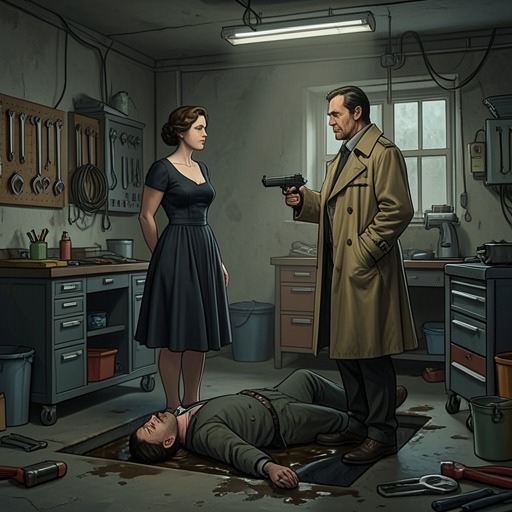
Vivian’s confession follows Marlowe’s reconstruction of the shooting. He tells her that, on the afternoon Rusty Regan disappeared, Regan took Carmen to the old wells to teach her to shoot. Instead of firing at the can he had set up, Carmen turned the gun on him, as she had later tried to do to Marlowe. Vivian’s response is immediate: she drops the gun from her knee and asks why Carmen did it. The dropped gun marks the moment Marlowe’s account becomes, for Vivian, an acknowledged family crime rather than a suspicion she can keep at a distance.
Vivian then says that Regan’s body is in the sump and that she went to Eddie Mars for help after Carmen came home and told her what had happened. She describes Carmen as not normal and fears that, if questioned by the police, Carmen would reveal the killing and might even boast of it. Vivian also believes her father would promptly tell the authorities everything if he learned the truth. Her concealment therefore rests on the chain of consequences she anticipates: Carmen’s disclosure, the exposure of the crime, and her father’s knowledge of it.
A decision made for her father
Vivian explains that she did not love Regan, though she considered him all right; to her, his life or death mattered less than shielding her father from the truth. She fears not only that General Sternwood would learn that his son-in-law was dead, but that he would spend his remaining time knowing what had happened. His illness makes the secret feel urgent: Vivian imagines that the shock would cause him to die that night. The explanation does not undo her decision; it shows the family loyalty and fear that govern it.
Her choice also entails dependence on Eddie Mars. Vivian says she knew he would bleed her white, but believed she needed help and could get it only from someone like him. Marlowe later identifies the scale of that bargain: fifteen thousand dollars, the established fee, was in Regan’s pockets when Carmen shot him, and he says that this was what Lash Canino received for disposing of the body after Vivian went to Mars. He contrasts that payment with what Mars expects to collect in the future. The concealment protects the family’s secret while making Vivian vulnerable to the man she enlisted to keep it.
The cover-up’s costs
The secret does not keep Carmen safely contained. Marlowe rebukes Vivian for letting her run around loose and get into further trouble. Vivian says she was playing for time, hoping Carmen might forget what happened during one of her fits; she acknowledges that she chose the wrong way. Her own account makes the strategy’s failure plain: rather than resolving the danger, delay leaves Carmen unsupervised, preserves the threat of discovery, and binds Vivian more tightly to Eddie Mars’s assistance. Vivian says there were times she could hardly believe what had happened herself, and that at other times she had to get drunk quickly. The cover-up has become something she must repeatedly endure as well as maintain.
Marlowe’s response sets a limit on his silence. He tells Vivian to take Carmen somewhere far away, where she can be cared for and kept away from weapons, and orders her to have Carmen watched every minute. He gives Vivian three days to leave; if she has not gone by then, he will disclose the truth. Vivian promises. He also tells her not to worry about Eddie Mars, saying that he will handle Mars after resting. The agreement is neither absolution nor a formal report: Marlowe gives her a short window to protect Carmen and her father, while reserving the power to expose the crime if she fails to act.
Family protection and moral compromise
The concealment joins a private family motive to a wider network of corruption. The opening image of the Sternwood estate places its wealth beside the old oil field from which the family made its money; much of that land has become public park, while some wells still produce. Later, the unused wells and polluted sump become the location of Regan’s body. Vivian’s effort to preserve the family from scandal cannot separate its domestic loyalties from the places, money, and powerful intermediaries that surround the crime.
Marlowe understands his own role as part of the same moral mess. After Vivian promises to take Carmen away, he reflects that death makes the place of burial immaterial to the dead, but that he himself has become part of the nastiness around Regan’s death. He distinguishes this involvement from the old man’s position: General Sternwood, he believes, should be spared the knowledge and allowed to remain quiet. Vivian’s concealment thus becomes a test of Marlowe’s professional and personal judgment as well as hers. He does not simply expose the truth or endorse the cover-up; he makes silence conditional on immediate action, protecting the father while insisting that the living daughter be watched and removed from danger.